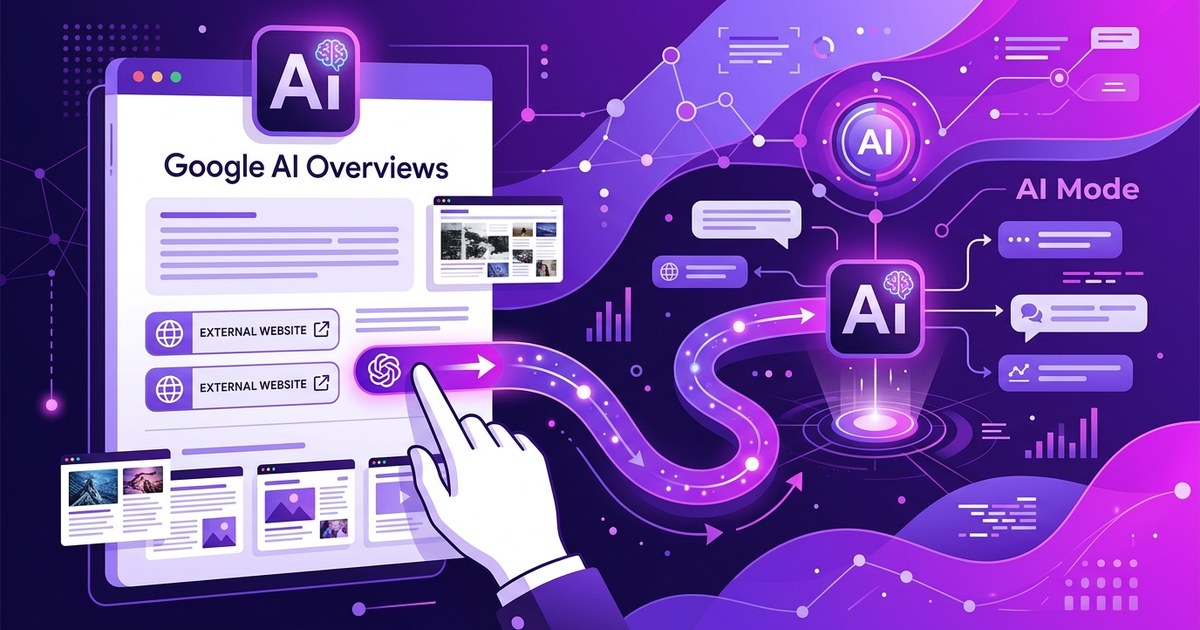
At first glance, Google appears to be displaying more and more links in AI Overviews, but not all of these links take visitors to external websites. Recent analyses by SEO researchers reveal that clicking underlined words in the AI summary sometimes redirects users to a follow-up conversation in Google AI Mode, rather than to the source page on the web.
Why this impacts your AI visibility
For business owners and marketers, this changes how visibility in Google AI Overviews should be interpreted. While a link in traditional search results always leads to an external webpage, some text links in AI Overviews act as an internal ‘trigger’ within Google.
This has two key implications for your marketing strategy:
- A distorted view of traffic: A visible link within the generated AI text does not guarantee that a visitor will actually end up on your website.
- No tracking in Search Console: Clicks that initiate a follow-up conversation in AI Mode are not recorded in Google Search Console as an impression or click for your website. Google only counts it as organic traffic once a user clicks through to your external URL.
What does this mean for you?
If you are focussing on AI search optimisation (GEO), it is wise not to focus solely on the presence of text links in AI responses. Consider the following practical steps to adapt effectively:
- Focus on source cards and carousels: External links in source cards alongside or below the AI response do send users directly to your website. Ensure your content is so clear and well-structured that AI models select your page as a primary source.
- Examine your analytics critically: Compare mentions in AI overviews with your actual organic traffic. A listed link does not automatically generate direct traffic.
- Anticipate follow-up queries: Because AI Mode encourages searchers to ask follow-up questions, your content should not only provide concise answers, but also address deeper follow-up questions. This ensures you remain visible as an authority throughout the subsequent steps of the AI conversation.
Source: Search Engine Journal